


Trafalgar Fire logo

I work in Plumbing  HVAC&R Electricial Passive Fire

Electricians

Here you can find all products that are required by Electricians for your Passive Fire Protection needs. Can’t find what you’re looking for? Head to the FyreSTOP Category to browse our complete collection of products!

FyreBOX Range

Want to learn more?

Check out some of the posts from our Knowledge Centre on Passive Fire Protection and how they affect your profession

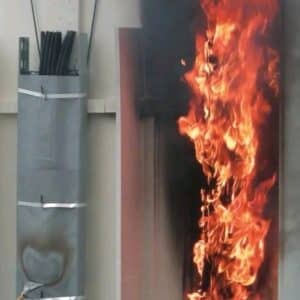
Trafalgar FyreWRAP foil-faced fire-rated insulation installed on a rectangular HVAC duct in an industrial ceiling, with fire in the background highlighting heat protection performance

Why FyreWrap is the Australian Standard for Duct Protection

If you’re looking for a better way to fire-rate ductwork without the mess of traditional sprays, FyreWrap has become the go-to solution in Australia. It’s essentially a lightweight, flexible blanket that wraps around ducts to keep them safe during a fire, and it’s much easier to work with than old-school vermiculite.

What builders and engineers really appreciate is that it’s a “dry trade”, meaning you don’t have to clear out the site for drying times or deal with wet overspray. It’s fully tested to meet the latest Australian safety standards (AS 1530.4), making it a reliable choice for everything from kitchen exhausts to smoke spill systems. It simply makes the path to building certification a lot smoother and cleaner.

Read More »
Curtain Walls

The Role of Curtain Walls as Vertical Fire Barriers

Think of the fire barrier at the edge of each floor as a high-rise’s invisible safety seal. While modern glass structures appear seamless from the outside, there is really a small gap between the floor and the outer wall that might allow a fire to grow upward, similar to a chimney. To keep everyone safe, we utilise a sophisticated fire barrier system, which often consists of mineral wool and fire-stop sprays, to seal the gap and confine any smoke or flames to a single floor. Understanding how these components interact to form a fire-resistant barrier allows architects and builders to ensure that their designs are not only beautiful but also actually durable in an emergency.

Read More »
SuperSTOPPER

How SuperSTOPPER Saves Labour Costs on High-Rise Builds

If you’ve ever managed a high-rise site, you know the “drill and fill” cycle is a massive headache. Waiting for slabs to cure just so a crew can spend weeks core-drilling holes only for another team to follow behind with manual fire collars is a slow, expensive way to build.
The SuperSTOPPER system changes that by moving the work to the pre-pour phase. Instead of reacting to the slab, you’re casting the fire protection directly into it. It’s a simple “orange box” that fixes to your formwork, meaning when the concrete sets, your fire-rated penetrations are already done. It effectively cuts out the need for drilling crews and those tedious post-pour sealing tasks, helping you get the trades through faster and keep your project moving without the usual bottlenecks.

Read More »
Duct Insulation Wrap

7 Signs Your Duct Insulation Needs an Upgrade (and How to Fix It)

If your energy bills are rising, some rooms never reach a comfortable temperature, or you notice condensation on ductwork, your insulation may be failing.
Over time, duct insulation can sag, become damaged, or lose effectiveness, forcing your HVAC system to work harder. Inspect accessible ductwork for gaps, damaged insulation, or air leaks, seal any loose joints, and replace worn insulation with high-quality materials suited to your environment.
In higher-risk areas such as kitchen exhausts or fire-rated zones, fire-rated solutions may also be required. Maintaining your duct insulation improves energy efficiency, comfort, and long-term system performance.

Read More »
Passive Fire

What are active and passive fire safety systems?

Fire safety is like a two-person team that works to keep you safe. There is an “active” side, which includes things like smoke alarms and sprinklers that go off when they are needed, and a “passive” side, which is basically the building’s own built-in protection.
The goal of passive fire protection is to keep fires from spreading. Fire-rated walls, doors, and hidden seals function silently to keep a fire in one location. These structural barriers keep the smoke out of your halls and make sure the structure stays standing long enough for everyone to get out safely, even when the alarms and sprinklers are busy putting out the fire. In short, active systems put out the fire, whereas passive systems give you time to get away.

Read More »
Passive Fire

8 Signs Your Building Needs New Pipe Insulation Immediately

If you’re noticing things like higher energy bills, damp patches near pipes, inconsistent water temperatures, or older insulation materials, your pipe insulation may no longer be doing its job. Worn or missing insulation can quietly lead to wasted energy, moisture damage, and safety or compliance concerns. Having it checked and replaced when needed can help keep your building running efficiently, protect the pipework, and avoid larger problems down the track.

Read More »